Speaker
Description
The field of microfluidics offers attractive possibilities to perform novel experiments that are difficult to execute using conventional methods [1]. First, the flow of liquids under submillimeter confinement leads to predictable and controllable flow profiles, along with well-defined chemical gradients and stress fields that can be used for controlled mixing and actuation on the micro and nanoscale. Secondly, intricate microfluidic device designs can be fabricated to perform complex tasks. Thirdly, microfluidic devices are usually compatible with in situ or integrated characterization methods that allow constant real-time monitoring of the processes occurring inside the microchannels.
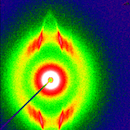
In this work we will focus on the use and prospects of combining microfluidic devices with in situ small-angle X-ray scattering (SAXS) for soft matter research. In a first example, we use this manipulation ability to create well-defined flowing interfaces to study the interplay between shear-flow forces and the structure of nematic liquid crystals and surfactant monolayers [2]. In a second example, we study the structural evolution of a lamellar phase undergoing a transition to a microemulsion in the SDS-pentanol-water ternary system by mixing with water or pentanol in a crossed microchannel configuration [3]. By manipulating the individual flow-rates, one can carefully tune the final composition following the concentration jump, and furthermore, probe different time-scales of the transition with SAXS. The main findings show that the lamellar to o/w microemulsion transition (by mixing with water) occurs through a gradual stripping down of bilayers from the lamellar phase, whereas the lamellar to w/o reverse microemulsion transition (through mixing with pentanol) involves the formation of an intermediate lamellar phase.