Speaker
Description
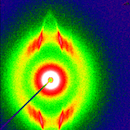
X-ray scattering techniques are well-suited for in situ investigations of the structural dynamics of complex fluids. The characteristic length scales of relevant microscopic structural features frequently fall into the range of 1 to 100 nm suitable for x-ray methods, while high brilliance synchrotron sources and continually evolving detector technologies provide opportunities to resolve time-dependent dynamic processes. This talk will highlight capabilities developed in our group for studying complex fluids subjected to extensional flow, drawing on two specific examples. First, investigations of an ordered block copolymer melt with BCC ordering of spherical microdomains will be discussed. Time-resolved SAXS measurements during inception of uniaxial flow reveal three distinct processes which occur simultaneously: deformation of the BCC lattice, reorientation of the lattice, and flow-induced disordering. At high extension rates, signatures of affine deformation of the initial lattice persist to large Hencky strains (up to ~ 1.5). Azimuthal concentration of intensity suggests that uniaxial extensional flow promotes orientation of the [100] direction of the BCC lattice along the flow direction. Second, we report studies of flow-induced alignment in a dilute suspension of multiwalled carbon nanotubes, seeking comparisons between shear and planar extensional flow. Transient and steady measurements of orientation in shear flow are fully consistent with expectations for Brownian rigid rods. Measurements of CNT orientation in planar extensional flow, performed using a high aspect-ratio cross-slot flow cell, show significantly higher orientation than found in shear. This cannot be explained for thin rodlike particles, but we hypothesize that a finite effective aspect ratio, stemming from the bent/crooked nature of the tubes studied here, leads to tumbling dynamics in shear that suppresses alignment relative to that found in planar extension.