Speaker
Description
Extensional flow is a major type of deformation in many polymer processing operations such as blow molding and fiber spinning. Extensional rheology of polymer melts is highly sensitive to molecular architecture and conformation. In the past four decades, people have made a great effort to study the dynamics of polymer chains in extensional flow in order to predict the rheological behaviour by using constitutive equations based on molecular theories (e.g. the tube model). However, while producing pure extensional flow in a highly controlled manner (e.g. constant strain rate) is already a challenge, rheology measurements give indirect information of molecular conformation in terms of stress-strain responses only. Thus combining state-of-the-art extensional rheometry with scattering techniques provides a powerful tool to understand polymer dynamics.
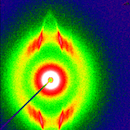
In this work, we measure the extensional rheology of polystyrene (PS) melts using a filament stretching rheometer which is able to produce a well-defined extensional flow. We show that the rheological behaviour of PS melts with different molecular architectures (linear and star shaped) is identical in fast extensional flow, indicating the same molecular conformation. The hypothesis of the same molecular conformation is confirmed in small angle neutron scattering (SANS). We also measure a bi-disperse PS blend containing linear chains of two molecular weights, and a monodisperse PS melt containing the short linear chains only, in stress relaxation following a fast extensional flow. By combing rheological measurements with SANS measurements, we show that there are nematic effects and strain coupling between the short and long chains in the blend. Furthermore, we show that the chain stretch idea in the tube model can be critically tested through analysing the SANS data at different time in stress relaxation process.