Speaker
Description
Hydrogels built from DNA are an attractive class of materials, whose structure and mechanical properties can be tuned by the design of “physical” cross-links based on selective Watson-Crick base pairing [Pan, Soft Matter 12,5537 (2016)]. Even simple systems of entangled DNA helices can display complex mechanical response, such as shear banding [Boukany, Soft Matter 5,780 (2009)] and strain hardening [Orakdogen, Macromolecules 43, 1530 (2010)]; however, in discussing such intriguing features, it is often disregarded that long DNA strands also undergo a transition to Nematic (N) liquid crystalline phase at concentrations as low as few mg/ml [Merchant, Biophys.J. 73,3154 (1997)].
We investigate the correlation among phase behaviour, structure and rheological properties in DNA helices of thousands of base pairs. In a wide concentration range, the solutions are viscoelastic while also displaying a continuous transition from Isotropic to N, without detectable phase separation. These solutions exhibit very low degree of ordering at rest, but strong, transient birefringence when sheared.
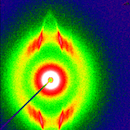
We measure the mechanical and optical response to continuous, oscillatory and step deformations across the transition region. To this aim, we combine rheology to real-space measurement of shear-induced alignment in a microscope shear cell, or through polarized reflection directly on the rheometer [Mykhaylyk, J. Polym. Sci. B 54,2151 (2016)]. Furthermore, through rheo-SAXS experiments we gain access to the local degree of alignment and structure.
We find that both shear stress and birefringence relax with two different time scales, a slow decay related to spontaneous disentanglement and a faster one, which we interpret as the result of the frustrated phase separation and local heterogeneity of the system. Regions with larger N order are more easily aligned and fluidized than the isotropic, viscoelastic matrix in which they are embedded, resulting in a faster optical and mechanical relaxation.