Speaker
Description
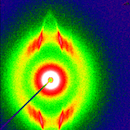
The mechanical properties of polymer melts under deformation are well described by the tube model developed in the 1970s by de Gennes and Doi and Edwards. In the model, the restricted motion of a chain due to its neighbors is modeled as if the chain ia confined to a tube. However, the validity of the tube model for rapid deformations compared to the molecular relaxation was recently questioned [1]. They proposed a new analysis method for anisotropic 2D small angle (neutron) scattering, SANS, data for uniaxially extended polymer melts expanding the data in spherical harmonics to ease the separation of the isotropic and anisotropic contributions. Using this method, they looked for the signature of chain retraction, see below, during relaxation after deformation which is a cornerstone of the tube model. The signature was absent in their data which lead them to conclude that chain retraction either does not occur or that it is shielded by some other non-linear effect not yet included in the model. However, we employ the same analysis also on SANS data for a polystyrene melt of about a factor of five lower molar mass stretched more than a factor of ten more, and we do see the proposed signature in the harmonics: The minimum in the expansion coefficient of the leading anisotropic contribution to the scattering pattern shifts towards larger q as the relaxation times approaches the Rouse time, τR. We therefore conclude that the relaxation of the molecular stretching and orientation are decoupled, or in other words that the chain retracts, which supports the tube model.
Chain retraction arises during relaxation if the deformation is fast enough to not only orient the chains but also stretch them. The hypothesis of the tube model is that the relaxation of the stretching of the molecule happens on a fast time scale, τR, through a Rouse-like process whereas the relaxation of the orientation happens on a much slower timescale through repetition. That these timescales are well separated causes the molecule to shrink in all dimensions for t∼<τR after deformation preserving its shape. Only for t>τR does it relax back to its equilibrium shape.